
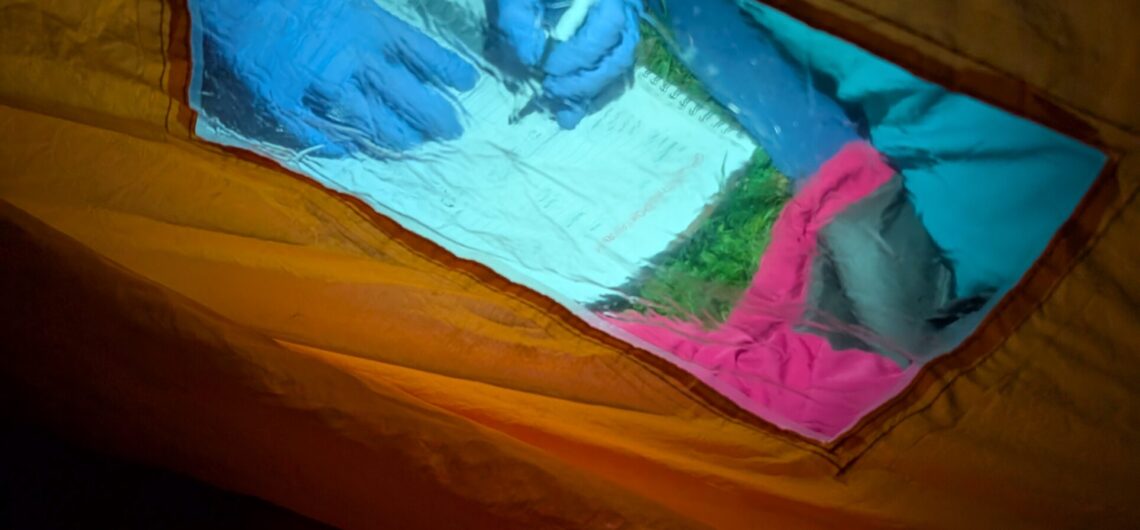
Imagine you’re halfway up a mountain, miles from the nearest road, when someone in your group slips and suffers a serious injury. You’ve assessed the casualty, provided first aid and called Mountain Rescue. Now you face another challenge: keeping track of their condition while waiting for help to arrive.
What time did the accident happen? Has their breathing changed? What treatment have you given? What medication do they take? What information will the rescue team need when they arrive?
In the stress of an emergency, remembering every detail isn’t easy.
This is where a Casualty Report Form becomes one of the most valuable pieces of equipment in your first aid kit.
It’s a simple bit of paperwork that can make a significant difference to how effectively you manage an incident, monitor your casualty and communicate with the emergency services.
Download our Casualty Report Form for FreeWhy Is a Casualty Report Form So Important?
1. It helps you stay organised under pressure
Even experienced first aiders can find a serious incident stressful. Add cold weather, difficult terrain, a distressed casualty or an anxious group, and it’s easy to become overwhelmed.
A well-designed casualty report form provides a structured approach, prompting you to work through your assessment systematically and helping ensure important information isn’t overlooked.
It’s particularly valuable for outdoor first aiders who may not regularly deal with serious medical emergencies.
Rather than trying to remember everything, you have a clear framework to follow.
2. It helps you recognise when a casualty’s condition is changing
One of the biggest challenges in outdoor first aid is that help may be some distance away.
Unlike in an urban environment, where an ambulance might arrive relatively quickly, a mountain rescue incident could involve an extended wait, particularly in difficult terrain or poor weather.
During that time, a casualty’s condition can improve or deteriorate.
Recording observations such as breathing rate, pulse, level of consciousness and pain score gives you a record of how their condition is changing.
For example, a breathing rate of 18 breaths per minute might not initially cause concern. However, if subsequent observations show it increasing to 24 and then 30 breaths per minute, that’s important information.
Trends can be just as important as individual readings.
By recording observations over time, you’re much better placed to recognise changes and pass that information to the emergency services.
3. It improves communication with Mountain Rescue and ambulance crews
When Mountain Rescue or an ambulance crew arrives, they’ll need a clear picture of what has happened.
You may have been caring for the casualty for an hour or more, but the rescuers are arriving with very little information.
A completed casualty report form allows you to provide a concise, structured handover covering:
- What happened and when.
- The injuries or medical problems identified.
- The casualty’s medical history and medications.
- Observations and how they’ve changed.
- What treatment you’ve provided and when.
Our form uses the ATMIST handover format, a widely used structure for communicating casualty information:
A – Age and sex
T – Time of incident
M – Mechanism of injury or illness
I – Injuries found or suspected
S – Signs and observations
T – Treatment given
Rather than relying on memory or trying to explain everything in a rush, you can give the rescue team a clear, organised account.
4. It provides an accurate record of what happened
Following an incident, it’s surprisingly easy to forget the precise sequence of events.
What time did you call 999? When did you first assess the casualty? What treatment did you provide? Did their condition change?
Having a written record can be valuable when completing incident reports, reviewing what happened or responding to subsequent questions.
For outdoor instructors, mountain leaders, activity providers and group leaders, accurate incident documentation is particularly important.
A casualty report form doesn’t replace your organisation’s accident reporting procedures, but it can provide useful information for those records.
Remember that casualty reports contain sensitive personal information and should be stored securely and only shared with those who have a legitimate need for it.
What Should a Good Casualty Report Form Include?
Not all casualty report forms are created equal.
For outdoor use, a form needs to be straightforward, practical and suitable for situations where you might be dealing with a casualty in cold, wet or challenging conditions.
At NG Mountaineering, we’ve developed our own Outdoor First Aid Casualty Report Form, drawing on the practical requirements of managing casualties in outdoor environments.
Our free two-page form includes:
Primary survey – DRcABCDE
A structured primary survey covering Danger, Response, catastrophic bleeding, Airway, Breathing, Circulation, Disability and Environment.
This provides a useful prompt during your initial assessment and helps you identify and prioritise life-threatening problems.
Information for Mountain Rescue
A dedicated section for recording important information when requesting assistance, including OS grid reference, what3words location, local hazards, contact numbers and group size.
These details can be particularly valuable when working in remote locations where finding and accessing a casualty may be challenging.
SAMPLE history
A structured way to gather important background information:
- S – Signs and symptoms
- A – Allergies
- M – Medications
- P – Past medical history
- L – Last ate, drank or went to the toilet
- E – Events leading up to the incident
Injury chart
Front and back body diagrams allow you to mark where injuries have occurred, recording details such as pain, swelling, bleeding, bruising and deformity.
This is particularly useful when dealing with multiple injuries following a fall.
Repeated observations
A dedicated table allows you to record the casualty’s observations over time, including their level of responsiveness, breathing rate, pulse, capillary refill time and pain score.
ATMIST handover
Finally, a structured handover section helps you summarise the incident and communicate the important details to Mountain Rescue, ambulance or other emergency responders.
How to Use a Casualty Report Form in a Real Emergency
The most important thing to remember is that treating the casualty always takes priority over filling in paperwork.
Never delay life-saving treatment or calling for emergency assistance simply to complete a form.
Once immediate priorities have been addressed, use the form to record your findings and treatment.
Where possible, consider asking another member of your group to act as a scribe. This allows you to concentrate on caring for the casualty while someone else records the information.
Continue to reassess the casualty and record observations at appropriate intervals, particularly whenever their condition changes.
When the emergency services arrive, use the completed form to support your verbal handover.
Download Our Free Outdoor First Aid Casualty Report Form
Download for FreeWe’ve made our NG Mountaineering Casualty Report Form available as a free PDF download for anyone who might find it useful.
Whether you’re a Mountain Leader, Rock Climbing Instructor, outdoor instructor, walking group leader or simply someone who enjoys spending time in the outdoors, we’d encourage you to keep a few copies in your first aid kit.
The form is designed to be printed on two sides of A4 and contains the key information you may need when managing a casualty in an outdoor environment.
Download the NG Mountaineering Casualty Report Form – FREE PDF
Our suggestion is to print several copies, keep them in a waterproof pouch and carry a pencil. You never know when you might need one.
A Good Form Is Useful. Knowing How to Use It Is Even Better.
A casualty report form is only as useful as the person completing it.
Knowing how to carry out a thorough primary survey, recognise a deteriorating casualty, monitor their condition and communicate effectively with rescue teams are all essential outdoor first aid skills.
At NG Mountaineering, our outdoor first aid courses focus on practical skills and realistic scenarios, helping you develop the confidence to manage incidents in the environments where you actually spend your time.
It’s not just about knowing what to do in the first few minutes. It’s also about understanding how to look after someone when professional help may be a considerable distance away.
If you’d like to develop your outdoor first aid skills, take a look at our 2 Day Outdoor First Aid Course.
Because good first aid isn’t just about what you do. It’s also about what you observe, what you record and how effectively you communicate it.