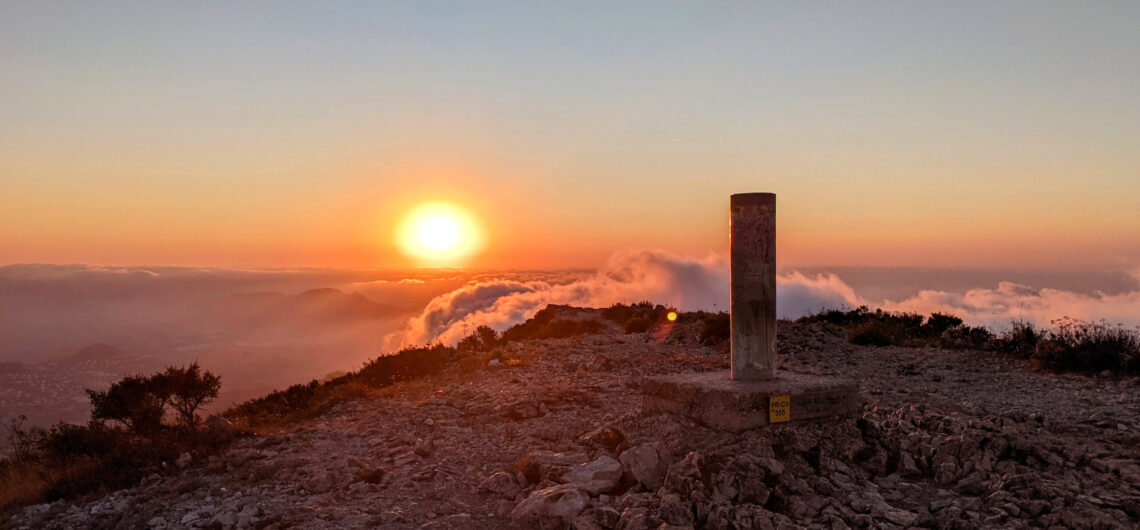
For me the hills and mountains are my sanctuary, a place to be happy, to achieve, to celebrate life. It’s where I go when I can’t see clearly, when I am lost and don’t know which way to turn, they are my escape, my salvation. They have seen me at my worst and my best. The John Muir quote ‘The mountains are calling and I must go’ perfectly explains how I feel. I connect to nature, experience a profound peace and a simplicity that fills me with content.
This year I turned 50, I have worked in the outdoor industry for over 20 years with most of this time spent living in the foothills of Spanish mountains. I regularly climb, run, trek and explore. I had an idyllic life in Spain, one I was very grateful for, but probably didn’t fully appreciate. In 2015 everything changed. I had a serious car accident. Sitting in my parked car, I heard a sudden loud screech, glancing up I saw a van veering towards me, brakes on, wheels locked. It’s a cliché but everything really did happen in slow motion. I saw everything with a surreal intensity, so clear and vivid, but the sounds were strangely muted and distorted, like being under water. The impact hit hard against the side of the car, everything shifted, my body involuntarily moved from one side to the other, hitting anything in its way, a fierce blow on the opposite side as my car hit another parked car pushing my body back and forth again, a bag on the seat seemed to defy gravity, levitating expelling it contents, glass cracked and splintered, floating around me. Eventually the movement stopped, everything fell silent and my senses diminished. I looked down, my mind disconnected from the reality of what was happening and I saw a body squeezed between a mangled mess of metal. This was the start not only of a long recovery but also my body being catapulted into early menopause.
The accident had caused severe lateral whiplash, inflamed internal organs, internal bleeding and my pelvis had been broken in 13 places. The consultant said the strength of my muscles (I was climbing lots at the time) had protected my body from further injury and I was lucky to be alive. The recovery was painfully slow, well it felt that way to me anyway, I was never very good at being patient (or being a patient!). My whole focus was to stop being a burden on my family and to get back to the mountains, walking and climbing again. Within six months I had rebounded, much weaker, but in the mountains and climbing very easy routes. That’s when I started to notice other small changes. I skipped the occasional menstrual cycle, I’d always been a regular 28-day cycle girl! Night sweats, I regularly, sometimes twice a night, woke in the middle of the night drenched from head to foot and freezing cold. I got into the habit of bringing a large soft towel to bed with me so I could lay it underneath me if I had one of these ‘episodes’. Eventually, twelve months after the accident and after spending a small fortune on home pregnancy tests, which were always negative, I went to my doctor. I assumed it was something to do with the accident, my bladder still wasn’t functioning properly, which meant I always had to wear a slim line pad in case of any escaping pee! After a week of waiting for blood tests results she said I was perimenopausal. I’d never heard of perimenopause so she went on to explain that it was the first signs that my hormones were changing and it was the step before being menopausal, indicated by 12 months periods free. I was only 43 years old, I felt too young to be menopausal, or more correctly perimenapausal! My doctor believed the accident had quite probably shocked my body into kick starting the menopause! Although a bit of a surprise, I didn’t give it much thought, the symptoms weren’t that bad and I wasn’t planning on any more children, so I was looking forward to being free of periods! Anyhow, I was still on a massive high of being alive!
The years went on and the same symptoms, night sweats and irregular periods, intermittently persisted but I didn’t notice much more. When I was 47 my periods stopped altogether. I thought, well that wasn’t too bad, I felt lucky.
I had always been a happy, focussed, determined person but since the accident I had become even more so, grateful for all the little things, enjoying life. I was often in pain culminating from the car accident and a previous paragliding accident, ten years prior, but it was manageable with daily stretching and exercise. I felt incredibly lucky, my life seemed better, more fulfilling in some indescribable way. I was trail running again, I’d just competed in my first OMM (Original Mountain Marathon) I was climbing hard (for me!). Life was good. It was at this point things started to change.
My emotions became erratic. My fitness seemed to fluctuate without any obvious reason. I kept losing my concentration, I sometimes became confused and struggled to focus. I forgot words, at times even putting sentences together was an achievement! My sleep patterns became irregular. My pain levels increased, sometimes at unmanageable levels. In turn this exasperated my already erratic sleep and mood. I also noticed that my weight was very slowly increasing, in fact over two years I would put on about 7 kilos. All of this had a massive impact on my relationship with the mountains. The most obvious consequence was due to my strength and fitness, some days I was able to function reasonably normally, other days I could barely walk up a small incline without feeling out of breath. I found these physiological things exasperating but generally manageable, there are always good and bad days. However my mood, focus and motivation took a huge hit. I would stumble and fall over, often this provided a funny anecdote, other times when on more precarious ground it would scare me. When climbing I started to make silly small mistakes. I had always been confident in my abilities and safety, but over a few months my confidence was broken and motivation non-existent. I felt like I was diving deep into a bottomless sea of darkness that seemed to be pulling me down further. I was angry and in pain. I was embarrassed and confused. For the first time in my life the mountains scared me, they weren’t providing me the solace they always had. I was lost.
I then moved back to the UK, during the pandemic. A new doctor, after I told her how I was feeling, told me that I may be depressed and very quickly prescribed antidepressants. I very rarely take any medication apart from ibuprofen, but I felt so bad I was glad to take them and for these confusing feelings to be alleviated! The drugs just made me feel worse and by day three I was violently vomiting. I stopped taking them and felt a bit better, but I still had the constant threat of doom lingering. I would often get a heaviness in my chest like everything was being sucked out of me leaving an empty space. I felt I was constantly balancing on the edge of some kind of unknown horror. By this point my internal dialog was continually berating, shouting at me to get a grip. I really didn’t like myself much. I tried hard to keep climbing and walking, some days were easier than others but I kept getting dragged back by my lack of confidence. I didn’t really speak to anyone because I couldn’t verbalise how I felt, I didn’t understand.
Eventually my pain levels got so bad that I had to take some time out for self care, so I booked a chiropractic appointment. The first session was incredible, so much so that two days later I cried with relief, I felt that a little of the pain had eased, I slept better and my mood lifted. This welcome space gave me time to think clearer and assess what was happening. By chance I read an article about menopause. I had assumed symptoms, night sweats, hot flushes & brain fog, ceased at the same time as periods. Apparently, this isn’t necessarily the case. For the first time I wondered if perhaps some of my seemingly unconnected feelings and symptoms were actually related. Further reading explained more and told me that oestrogen is more accurately a group of steroid hormones, the three more prevalent being estrone (E1), estradiol (E2), and estriol (E3), and isn’t just related to fertility, its uses and effects on our bodies are far more reaching. Oestrogen is key in regulating energy production and balancing the brain functions, as well as keeping brain cells healthy and active. Oestrogen is a neuro-protective hormone, crucial to boosting the immune system. Oestrogen also influences chemicals that soothe the nervous system, promoting the release of endorphins, the body’s natural pain killers. This is one impressive set of hormones, and yes this quite possibly is what has been causing all of the changes in my body, including weight and pain increase!
I wasn’t ready, at the age of 50, to give up on climbing, running and mountaineering. I realised I desperately wanted and needed to be in the mountains. I know women have very different experiences of menopause and I needed to find the right approach that worked for me. As the chiropractor had made such an impact I decided to invest in two monthly sessions. I use the word invest, as it was and still is an investment in my life, future and also to those around me, who have also been impacted by the way I have been over the past few years. I started pilates exercises, focusing on alleviating pain and targeting key areas of pain in my body. I then gradually increased the amount of exercise. I run between 3 and 5k most days and include a 20 minute weights routine. I read that, for menopausal women, including weight lifting in your exercise routine is hugely helpful, increasing muscle mass and decreasing fat cells. I had always eaten reasonably healthily but my sugar intake (mainly chocolate!) had increased so I replaced this with fruit and healthier snacks. I also increased the number of seeds, veggies, such as kale and sprouts, and tofu in my diet, all of which contain oestrogen naturally. Finally I am trying to be kinder to myself. As a mum I have always struggled to juggle the responsibilities of kids, work and the guilt of never seeming to get it right. I am now including, wherever possible, more time for me in my routine, this has always been hard in the past, and guilt has played its part, however my kids are older now, the youngest about to go to uni, so it is so much easier. I am still working on changing my internal dialogue, trying to speak nicer to myself. This stage is much more difficult, the destructive habit of putting myself down I have realised has been present for many years. Speaking to friends it seems we all experience this from time to time. I would never speak to another person how I speak to myself, changing my internal voice is a process and I am working on it!
The impact of relatively small changes has been huge. Although I haven’t yet lost any kilos, everything else has improved. I feel fitter and healthier. I am doing longer treks and runs. I am running by myself and taking on new challenges. I am climbing and bouldering again.
Menopause is a huge subject, I am no expert. It seems that we are only now talking more about the effects of menopause, but it still carries either a level of shame or embarrassment and certainly many still belittle its impact, as one of those things that every woman goes through. Of course by talking about it I hope we can become more aware and search for ways to help ourselves. For me it was only with hindsight, looking back on the past few years, that I can recognise the signs. Even now I am not sure which symptoms were related to the menopause or the accident. Probably together they created the perfect storm of symptoms which very quickly caused chaos. What I know now is that my head is clear. I have my confidence back and I am in love with being in the mountains again. I have found my peace.
I believe the outdoors can be an incredibly healing place, as well as challenging and helping to keep you fit.
Further reading:
I thoroughly recommend reading anything by Lisa Mosconi, especially the XX Brain. Lisa Mosconi is a neuroscientist who’s research is focussed on how genetics, environment and lifestyle affect the brain. Her books are easy to read, engaging and most importantly positive, reassuring us that it is never too late to make changes. Her podcasts are also great, she explains things simply, has a beautiful voice and laughs freely making her very relatable.
The XX Brain – although in the title says it helps to fight Alzimers, it has huge sections on oestrogen and its effects throughout our lives. In fact there is a section completely dedicated to the menopause. It is such a fantastic guide to how our brains work.